
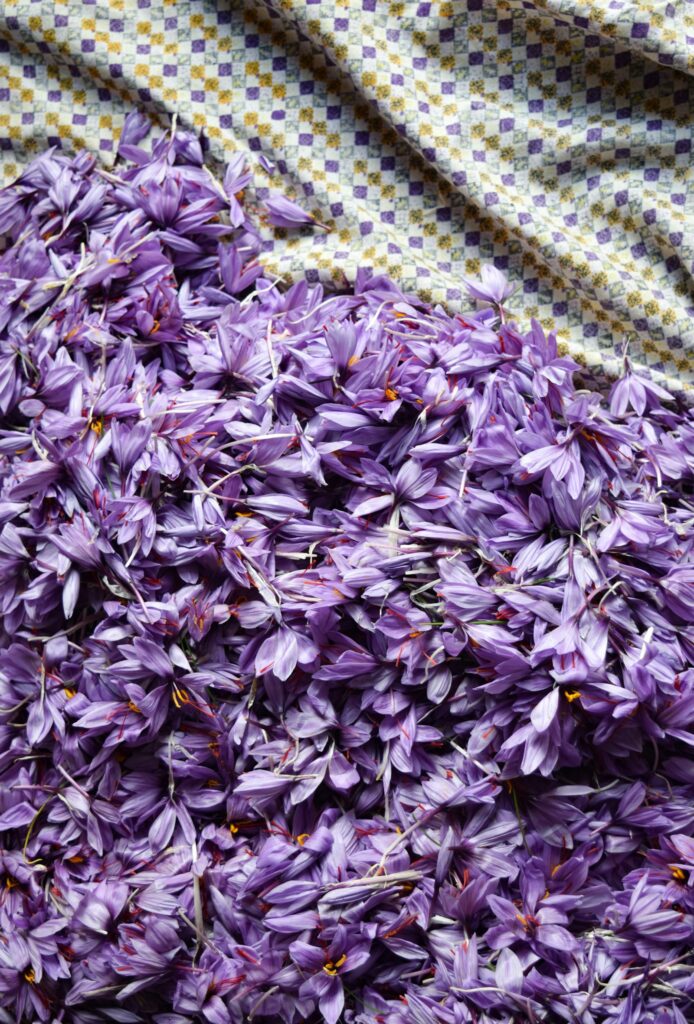
Every autumn, for a few short weeks, the fields around Pampore in Kashmir and across Khorasan in eastern Iran turn violet. Before sunrise, pickers move along the rows, gathering small purple crocus flowers by hand while they are still closed against the cold. By evening, the three slender red threads inside each flower have been pulled out and laid to dry. This is saffron, the most expensive spice in the world, and one of the most beautiful notes in perfumery.
Saffron in perfume is not a modern fashion. It has scented baths, temples, textiles and attars for thousands of years. Today it is having a quiet golden age, threaded through oud blends, rose perfumes and soft leathers alike. Here is where it comes from, what it really smells like, and how to wear it well.
From a violet flower to a crimson thread
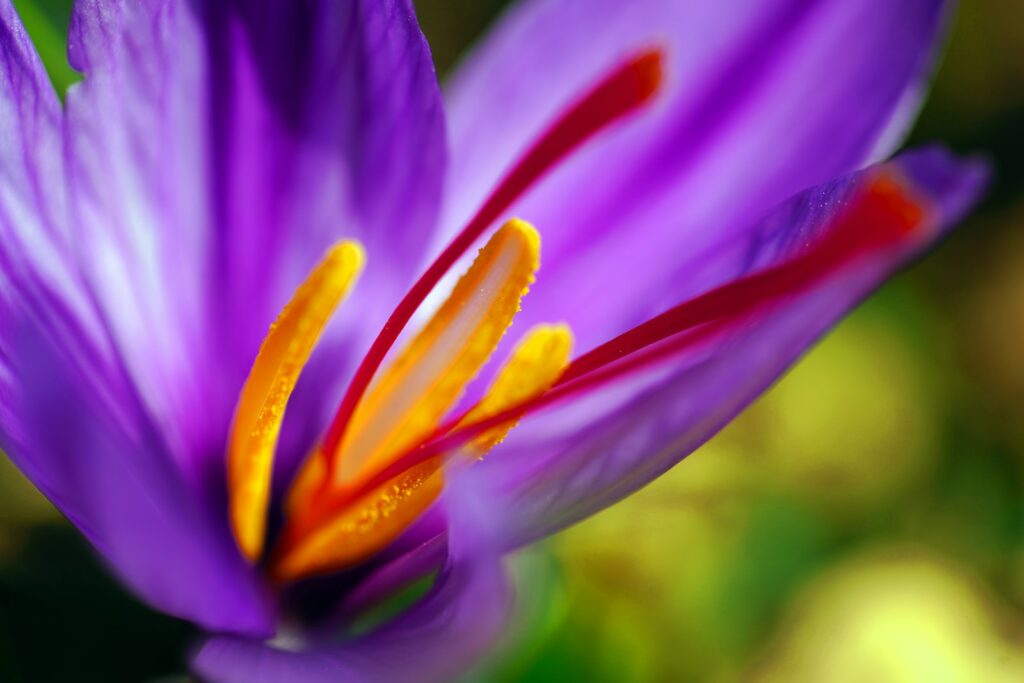
Saffron comes from Crocus sativus, an autumn-flowering crocus that no longer grows in the wild. It cannot set seed, so every plant in every field has been grown from a corm, the bulb-like base of the plant, passed from farmer to farmer over generations.
Each flower holds just three crimson stigmas, the threads that become saffron. They have to be picked by hand, quickly, before the sun wilts the petals. It takes somewhere around 150,000 to 170,000 flowers to make a single kilogram of dried saffron, which is why it has always been treasured, and priced, like a precious metal.
Iran grows the vast majority of the world’s saffron, most of it in the province of Khorasan. Kashmir is the other great name, with its fields centred on Pampore, a town whose old name is often said to mean “land of gold”. Spain, Afghanistan, Greece and Morocco grow smaller amounts, each with a character of its own.
A spice with a long perfumed past
On the island of Santorini, volcanic ash preserved a set of Bronze Age wall paintings in the town of Akrotiri. Among them are women gathering crocus flowers, painted around 3,500 years ago. They are some of the earliest images of saffron we have, and they show how precious it already was.
In ancient Persia, saffron was used as a dye, a medicine, an offering and a perfume. Threads have been found woven into royal textiles. The Greeks and Romans scattered it in halls and theatres to sweeten the air, and wealthy Romans added it to their baths. Later, the Moors carried the crocus into Spain, where the plains of La Mancha still grow it today.
Further east, saffron became part of the language of luxury. It coloured the robes of monks, flavoured the rice of royal kitchens and found its way into perfume oils. In the attar tradition of India, saffron was blended with sandalwood and rose to make rich, warming oils for the cooler months. Many of those oils are still distilled in the traditional way today.
What does saffron smell like?
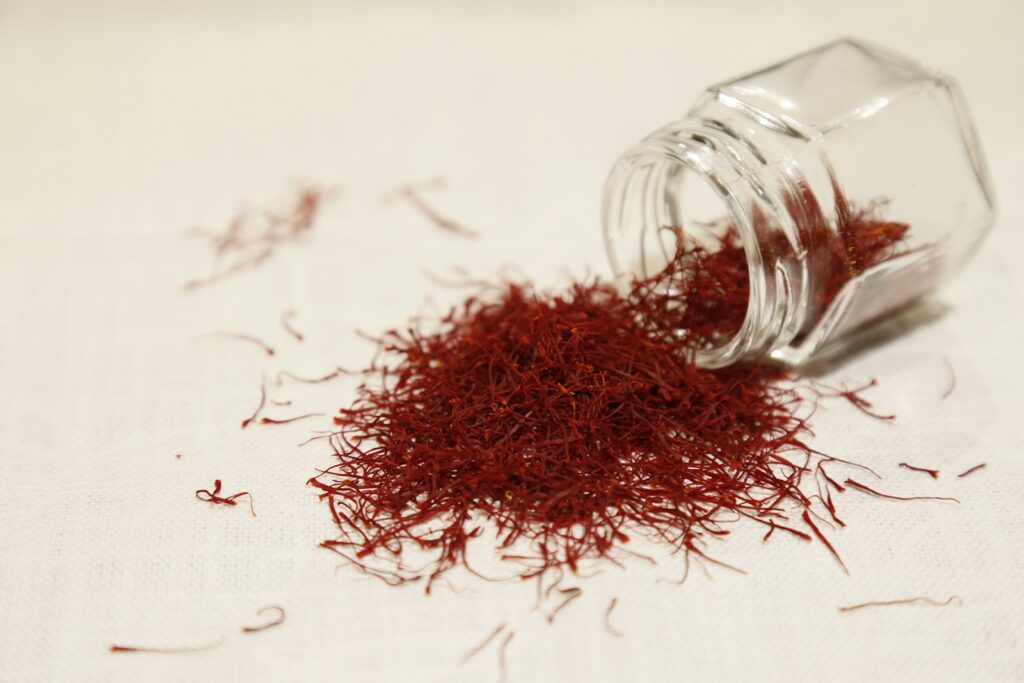
Open a jar of good saffron and the scent is surprisingly complex. It is not sweet like vanilla, nor sharp like pepper. Most people describe it in layers:
- Honeyed and hay-like. A dry, sun-warmed sweetness, like dried flowers or summer straw.
- Leathery. A soft, suede-like warmth that gives saffron its sense of luxury.
- Slightly metallic and bitter. A faint iodine edge that keeps it from feeling sugary.
- Gently floral. A hint of something petal-like, which is why it sits so naturally beside rose.
Much of this comes from a molecule called safranal. Fresh stigmas barely smell at all; safranal forms as the threads dry, when a bitter compound inside them slowly breaks down. That is why the drying and curing of saffron matters so much to its final scent, just as it does to its flavour.
How perfumers capture saffron
You might imagine that a saffron perfume is made by soaking threads in oil. In practice, natural saffron extracts do exist, but they are extremely costly, vary from harvest to harvest, and carry a lot of colour. They are used sparingly, mostly in artisan and attar work.
Most saffron notes in modern perfumery are built by the perfumer rather than pressed from the flower. They combine aroma molecules that echo saffron’s character with other materials to round it out. One of the best known is Safraleine, created by the fragrance house Givaudan, which smells warm, spicy and leathery, with a velvet softness that reads clearly as saffron. Used in tiny amounts, molecules like this let perfumers give a fragrance that golden glow consistently, bottle after bottle.
This is not a compromise. It is the same art perfumers have always practised: building an impression of something precious from many parts, so that it smells more like itself than the raw material ever could.
Saffron’s favourite partners
Saffron is rarely the whole story in a perfume. It is more often the spark at the opening, or the warm thread that ties a composition together. A few pairings have become classics.
Saffron and oud. Perhaps the most loved combination in Middle Eastern perfumery. Saffron’s honeyed leather softens the dark, resinous depth of oud, and makes it easier to wear. You can read more about that remarkable wood in our story of what oud really is.
Saffron and rose. Rose brings a fresh, jammy brightness; saffron lends it gravity and warmth. Together they feel both romantic and grown-up. Our own Damascus Oud is built on this trio, opening with saffron, pear and bergamot over a heart of Bulgarian rose and jasmine, and settling into oud oil and patchouli. If you want to experience how saffron behaves in a blend, Damascus Oud is a gentle place to start.
Saffron and amber. Resins, vanilla and labdanum turn saffron golden and glowing, perfect for winter evenings.
Saffron and leather. Saffron already has a suede-like edge, so it slips naturally into leather accords, making them smoother and more refined.
How to choose and wear saffron in perfume
Saffron is a warm note, and it shines when the air is cool. Here in Pakistan, it comes into its own from November through to early spring, for winter weddings, long dinners and evening gatherings. In the heat of summer, a little goes a long way.
- Test it on skin, not paper. Saffron changes as it warms. The first minutes can feel bright and slightly bitter; the leathery, honeyed heart appears after half an hour.
- Look at what surrounds it. Saffron with rose feels elegant and soft. Saffron with oud feels deep and regal. Saffron with amber feels cosy and sweet. Choose the partner you love.
- Apply lightly. Saffron perfumes, especially perfume oils, have presence. Two or three touches on pulse points are usually enough.
- Layer with intention. A saffron scent worn over a simple rose or a soft musk can make both feel richer without becoming heavy.
- Store it well. Like saffron in the kitchen, saffron perfumes prefer a cool, dark place, away from sunlight and steamy bathrooms.
The golden thread
There is something fitting about a note that takes so much care to make. Every thread of saffron is picked by hand in the cold of an autumn morning, dried slowly, and treasured. When you wear it, you carry a little of that patience with you: a warm, glowing trace that has travelled from Bronze Age frescoes to the attar shops of the East, and onto your skin.
Frequently asked questions
Is the saffron in perfume real saffron?
Sometimes. Natural saffron extracts are used in some artisan perfumes and attars, but they are very expensive. Most modern saffron notes are recreated by perfumers using aroma molecules that capture its warm, leathery, honeyed character, which keeps the scent consistent and affordable.
Is saffron perfume for men or women?
Both. Saffron is one of the most naturally unisex notes in perfumery. Paired with rose it often feels softer and more romantic; paired with oud or leather it reads deeper and more traditionally masculine. The blend matters more than the note itself.
Does saffron perfume last long?
Saffron itself usually appears early in a fragrance, but it is often anchored by long-lasting partners such as oud, amber, patchouli or musk. In a well-built perfume oil, its warmth can linger on skin for many hours.
When is the best time to wear saffron?
Cool weather and evenings suit saffron best. It is a lovely choice for winter weddings, festive dinners and special occasions, and a single light application works well on cooler days at any time of year.