
In the dry hills of Dhofar, in southern Oman, a harvester walks up to a short, twisted tree with papery bark and almost no leaves. With a small, flat-bladed tool he shaves away a patch of bark the size of a coin. Within minutes a milky sap begins to bead from the wound. Over the following weeks it hardens in the sun into pale, translucent drops. This is frankincense, the resin that once travelled by camel caravan to the temples of Egypt, Jerusalem and Rome, and that still scents homes, mosques, churches and perfumes today.
Few materials in the history of fragrance carry as much weight. Frankincense helped build cities, fill royal treasuries and shape the very idea of perfume. Here is where it comes from, how it is gathered, and why perfumers still reach for it thousands of years later.
What is frankincense?
Frankincense is an aromatic gum resin produced by trees of the genus Boswellia. Several species give it, and each has its own character. Boswellia sacra grows in Dhofar and neighbouring Yemen, and is the source of the famous Omani resin. Boswellia carterii (often treated as the same species as sacra) and Boswellia frereana grow in Somalia, while Boswellia papyrifera grows across Ethiopia, Eritrea and Sudan. India has its own species, Boswellia serrata, long used in Ayurvedic practice.
In Arabic the resin is called luban, from a root linked to milk, a nod to the white sap that first appears when the bark is cut. In Pakistan and India you may hear loban, although that word is used loosely and often refers to other resins, such as benzoin, as well. The older European name, olibanum, is the one you will still see on perfumers’ ingredient lists.
How frankincense is harvested
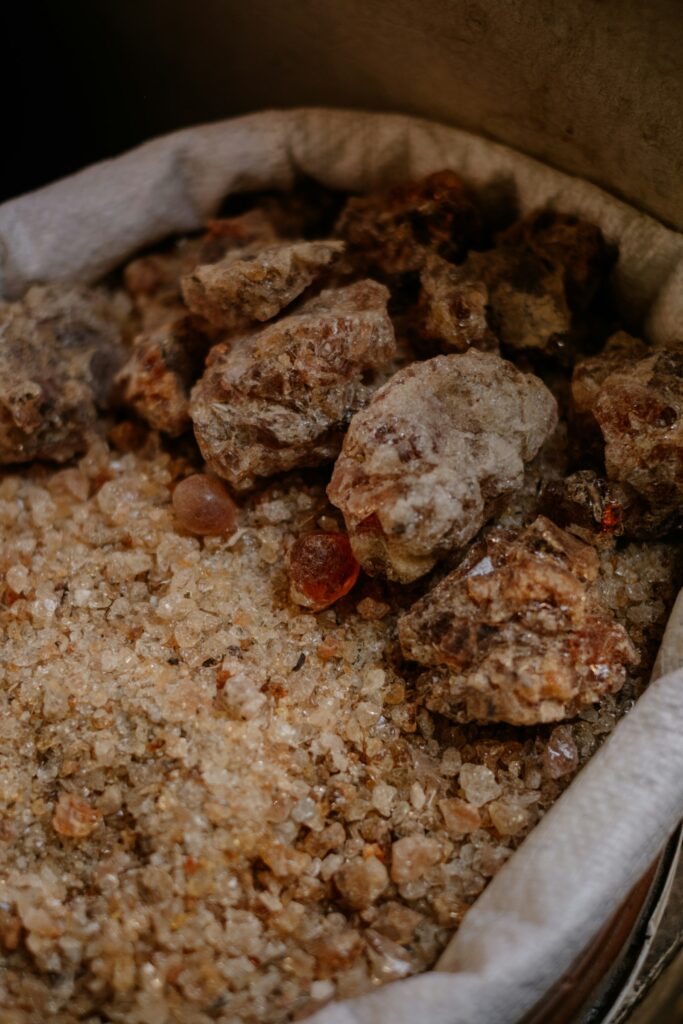
The method has barely changed in thousands of years. In Oman the harvester uses a manghaf, a short blade with a wooden handle, to make a handful of shallow cuts in the trunk and main branches. The first flow of sap is usually left to harden and then scraped away; it is the later tappings, made in the same places a couple of weeks apart, that give the best resin.
Each time, the sap is left on the tree to dry into “tears”, the small rounded lumps you see in markets. In warm weather this takes roughly two to three weeks. The work is slow and seasonal, and a good harvester knows when to stop: after a season or two of tapping, a tree is rested so it can recover.
Not all frankincense is equal. In Oman, the most prized grade is Hojari, gathered from trees growing on the dry inland side of the Dhofar mountains, away from the monsoon mist. The best pieces are pale, almost silvery green or creamy white, and slightly translucent. Darker, smaller or dustier pieces are generally sold as lower grades and are usually burned rather than distilled.
The incense route: a fortune carried by camel
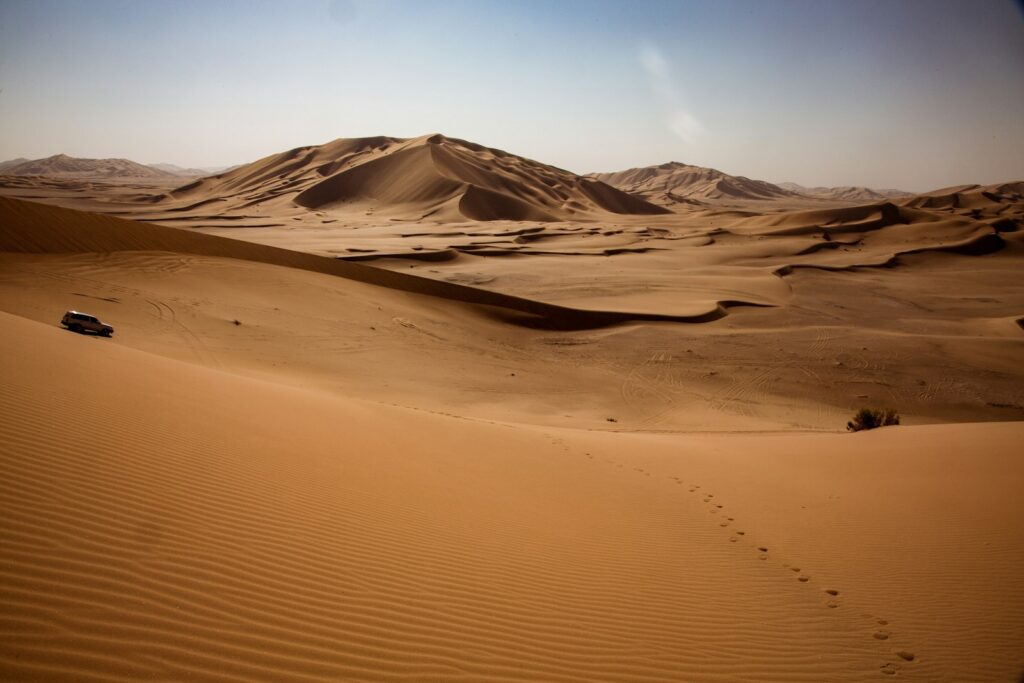
Frankincense only grows in a narrow band of southern Arabia and the Horn of Africa, yet for centuries the whole ancient world wanted it. That gap between supply and demand created one of history’s great trade routes.
From the groves of Dhofar and Yemen, caravans carried resin north through the kingdoms of southern Arabia, along the edge of the desert, to the markets of the Levant and the ports of the Mediterranean. Along the way grew rich trading towns, among them Petra, the rose-red city of the Nabataeans, who controlled much of the northern stretch of the route. Other cargoes moved by sea, across the Red Sea and the Indian Ocean.
Egypt was buying incense from the land it called Punt long before then. Queen Hatshepsut’s famous expedition there, around the fifteenth century BCE, is carved into the walls of her temple at Deir el-Bahari, complete with incense trees being carried back in baskets. Centuries later, the Roman writer Pliny the Elder complained about how much money flowed east to pay for Arabian aromatics, and recorded the story that the emperor Nero burned more incense at the funeral of his wife Poppaea than Arabia could produce in a year.
In 2000, UNESCO inscribed four sites in Dhofar as the Land of Frankincense World Heritage Site: the frankincense trees of Wadi Dawkah, the caravan oasis of Shisr, and the ancient ports of Khor Rori (the town of Sumhuram) and Al-Baleed.
Smoke, prayer and the word “perfume”
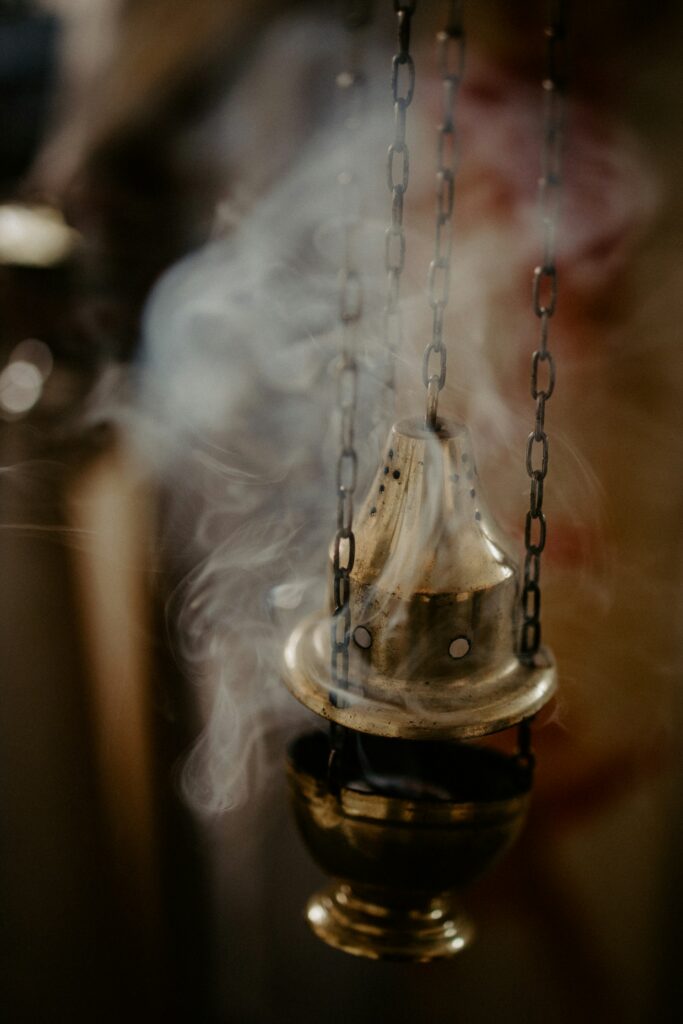
For most of history, frankincense was not worn; it was burned. Its smoke rose in Egyptian temples and Roman altars, and it still drifts through Orthodox and Catholic churches during services. The Gospel of Matthew lists it, alongside gold and myrrh, among the gifts brought to the infant Jesus.
Our word “perfume” is usually traced to the Latin per fumum, “through smoke”. Whether or not the etymology is exact, it captures something true. Long before alcohol-based sprays, fragrance meant resins, woods and spices smouldering over coals, and frankincense was the most important of them all.
Frankincense at home: bakhoor and the majmar
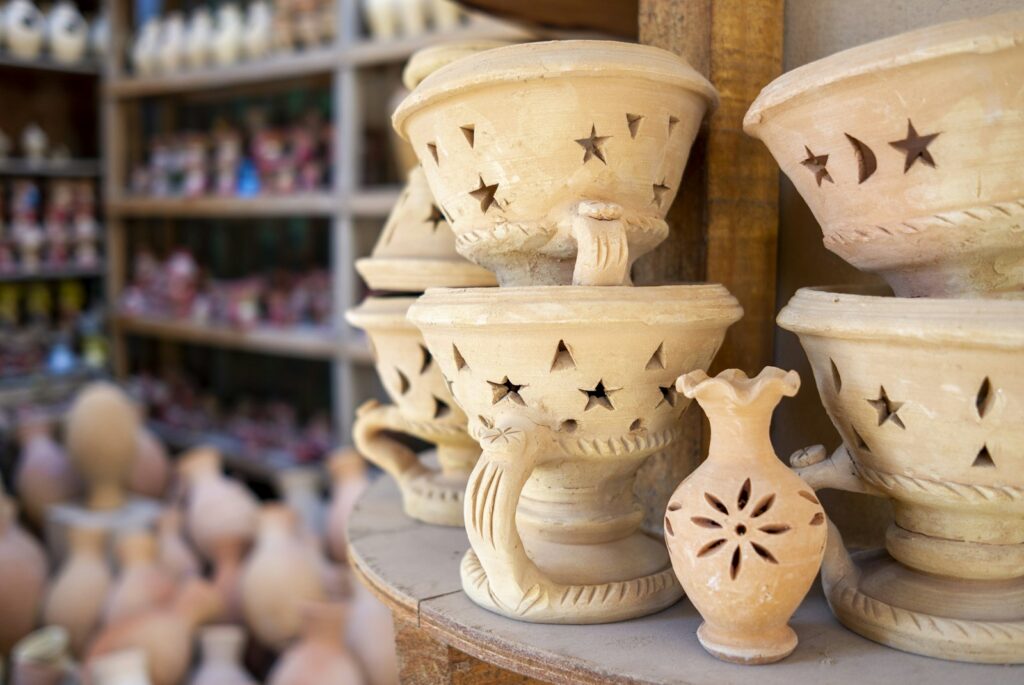
In Oman and across the Gulf, burning frankincense is part of everyday hospitality. A few pieces are placed on a hot coal in a majmar or mabkhara, a small clay or metal burner, and the smoke is wafted through rooms, over clothes and around guests as a gesture of welcome. In Omani souqs you will find whole stalls of hand-thrown clay burners, many painted or pierced with stars and crescents.
The same habit lives on in South Asia, where resin burned on coals perfumes homes on Fridays, at weddings and during gatherings.
How perfumers use frankincense
Perfumers work with frankincense in several forms. Steam distillation of the resin gives an essential oil that is bright and airy. Solvent extraction gives a resinoid or absolute, which is deeper, sweeter and more balsamic. CO2 extraction sits between the two and keeps more of the resin’s full character. Distillation yields are modest, often only a few kilos of oil from every hundred kilos of resin, which is part of why fine frankincense oil is costly.
So what does frankincense smell like? It opens fresh and almost sparkling, with notes of lemon peel, pine needles and black pepper, thanks largely to natural molecules such as alpha-pinene and limonene. As it settles it turns warm, resinous and faintly woody, with the cool, mineral, slightly smoky quality many people describe as “church-like”. It is less sweet than benzoin and less bitter than myrrh.
That two-sided nature makes it extremely useful. In a composition it can lift the opening, add a clean, luminous glow to the heart, and give the base a soft, lasting resinous trail. You will find it in incense and amber accords, in woody and leathery blends, and in many attars. It pairs beautifully with rose, oud, saffron, myrrh, labdanum, sandalwood and vanilla.
Choosing and caring for frankincense
If you buy raw resin to burn at home, look for clean, pale, slightly translucent tears with a fresh, lemony scent even when cold. Store resin in a glass jar with a tight lid, away from heat and sunlight, so its brighter notes do not fade.
Frankincense essential oil should never be applied to the skin undiluted. If you use it at home, dilute it properly in a carrier oil and try a small patch test first.
A resin with a future to protect
The trees that give frankincense grow slowly, often in harsh and fragile landscapes, and they are under pressure. A 2019 study led by researchers at Wageningen University found that populations of Boswellia papyrifera, today a major source of the world’s frankincense, are declining, and projected that production could halve within about twenty years. Over-tapping, grazing, fire and insect damage all play a part.
In Oman, the trees of Wadi Dawkah are protected, and there is growing interest in traceable, carefully managed harvests. For anyone who loves this resin, it is worth asking where it comes from and buying from sellers who can answer.
Frankincense has scented temples, trade routes and royal funerals, and it still lingers in Omani homes and church naves today. It is a reminder that perfume began as something shared in the air, long before it was worn on the skin. If its story draws you in, you may also enjoy reading about attar, the ancient art of perfume oils.
Frequently asked questions
What does frankincense smell like?
Fresh and resinous at once. It opens with citrus and pine-like notes, then softens into a warm, slightly smoky, balsamic scent that many people associate with churches and incense ceremonies.
Is frankincense the same as loban?
Sometimes. In Arabic, frankincense is called luban. In Pakistan and India, the word loban is often used for frankincense but also for other resins, especially benzoin, which smells sweeter and more vanilla-like. If you want true frankincense, look for the name olibanum or the species Boswellia.
Which frankincense is considered the best?
Omani Hojari, from Boswellia sacra trees in the dry interior of Dhofar, is widely regarded as the finest.
Is frankincense used in modern perfumes?
Yes, very often. It appears in many woody, amber and incense fragrances, and in traditional attars, usually as a heart or base note that adds a clean, resinous glow and helps the scent last.